
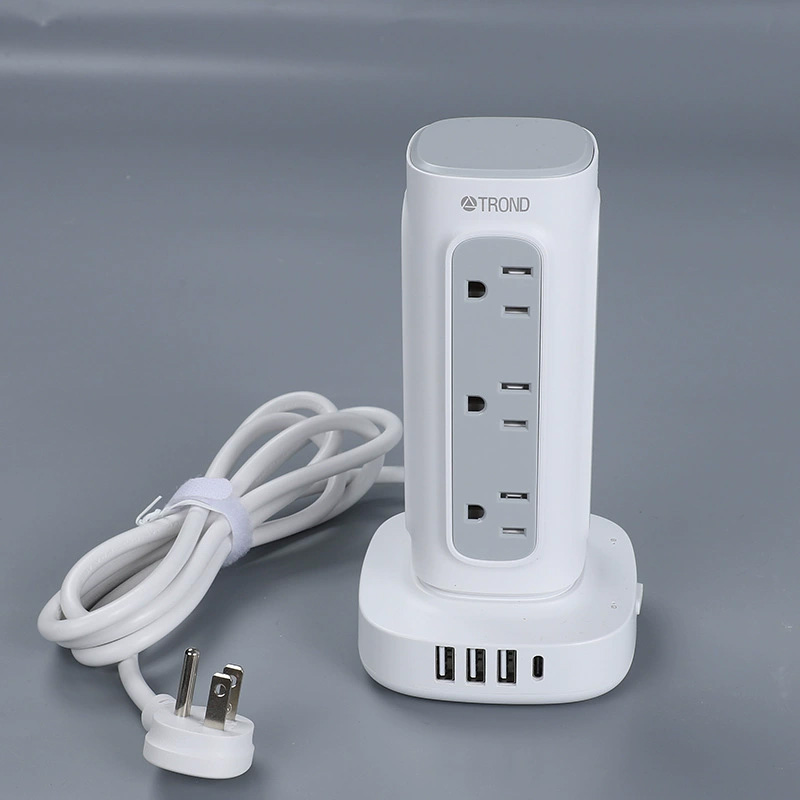
The Gap Between Port Count and Charging Reality
A charging socket described as "4 USB ports, 2.4 A" invites an assumption that is not true: that each port delivers 2.4 A simultaneously. In most multi-port designs the total output is limited and shared, so the per-port current falls as more devices are connected.
Dongguan Yisheng Electronic Technology Co., Ltd. produces USB power supplies, USB chargers, car chargers and USB power strips for buyers in more than 40 countries, and the specification conversations that need the most care are the ones about USB output. The reason is that USB charging is a negotiation, not a supply — the port and the device agree on a voltage and current before any power flows.
The USB Charging Landscape: Three Generations at Once
| Generation | What it does | Practical limit |
|---|---|---|
| USB BC 1.2 (legacy) | Charging downstream port; device detects a charger by shorting D+ and D− | Typically 1.5 A at 5 V |
| Fast-charge protocols (QC, AFC, FCP, SCP) | Voltage negotiation over the data lines; raises voltage to raise power | Commonly up to 12 V or 20 V depending on version |
| USB Power Delivery (PD) | Bidirectional negotiation over USB-C CC line; defines fixed and adjustable voltage contracts | Up to 100 W (20 V / 5 A) on PD 3.0; higher with PD 3.1 EPR |
All three coexist in the field. A charger that supports only BC 1.2 will charge a modern phone slowly and safely; a charger that supports PD will charge it fast, but only if the cable and the device also support PD.
USB Power Delivery: What "PD" Actually Means
PD is a contract. The charger advertises the voltage and current combinations it can supply, the device requests one, and both sides agree before power transfers. The standard contract ladder on PD 3.0:
| Contract | Voltage | Max current | Max power |
|---|---|---|---|
| 5 V | 5 V | 3 A | 15 W |
| 9 V | 9 V | 3 A | 27 W |
| 12 V | 12 V | 3 A | 36 W |
| 15 V | 15 V | 3 A | 45 W |
| 20 V | 20 V | 5 A | 100 W |
Two consequences follow for a buyer. The cable matters as much as the charger. A cable without the required current-carrying conductors or the CC wire will negotiate a lower contract, so a 65 W charger can deliver 15 W through a charge-only cable. A PD port's rating is conditional. A port that supports 20 V / 5 A may deliver that only when the other ports are unused; a multi-port charger's PD contract is often reduced once a second device is connected.
Multi-Port Power Sharing: The Specification Most Buyers Miss
When several devices share one charger, the total output is divided according to a fixed priority scheme, not according to demand. Typical behaviours, from simplest to most sophisticated:
- Fixed per-port caps with a shared ceiling. Each port may draw up to its own limit but the sum cannot exceed the charger's total. Connecting a second device reduces what each port can deliver.
- Priority allocation. One port is designated fast-charge and retains its full contract; remaining power is distributed among the other ports.
- Dynamic redistribution. The charger reallocates as devices finish charging, returning capacity to the ports still in use.
For a specification, state three numbers rather than one: the total output, the per-port maximum, and the per-port output when all ports are occupied. A "2.4 A" claim with no stated total is incomplete, and a buyer comparing two suppliers on the per-port figure alone will not be comparing equivalent products.
The advertising claim on many products — "2.4 A fast charge" — describes the peak of a single port under the most favourable condition. That is a legitimate figure if it is labelled as such, and a misleading one if it is presented as the everyday output of every port.
Protection Circuits: What Sits Between the Mains and the Device
A charging port is a power supply, and a power supply needs protections that fail predictably. The protections worth naming in a specification:
| Protection | Condition it addresses | What happens |
|---|---|---|
| Overcurrent protection (OCP) | Device draws more than the port can safely supply | Current is limited or the port shuts down and retries |
| Overvoltage protection (OVP) | Output rises above the negotiated contract | Output is cut before the device is stressed |
| Short-circuit protection (SCP) | Port output is shorted (damaged cable, debris in the connector) | Output is cut immediately; port restarts when the fault clears |
| Over-temperature protection (OTP) | Internal temperature exceeds a threshold under sustained load | Output is reduced or cut until temperature falls |
Two design details decide how well these behave in practice. Hiccup versus latch-off: a hiccup-mode protection cuts output, waits and retries automatically, which is friendlier for a consumer product; a latch-off protection stays off until power is cycled, which is safer in some fault conditions but confusing for a user. Per-port versus shared sensing: sensing current per port catches a single faulty device; sensing only the total lets one bad port hide behind the others.
Certifications That Apply to a Charging Product
For a product that plugs into mains and supplies USB power, the certification set is the union of an electrical appliance and an information-technology device:
- Safety: UL / ETL (North America, typically UL 60950-1 or UL 62368-1), CE with the applicable EN standard in the EU, UKCA in the United Kingdom.
- Electromagnetic compatibility: FCC Part 15 in North America; EMC Directive compliance in the EU.
- Substance compliance: RoHS, and REACH where the destination market requires it.
- Efficiency and standby: relevant efficiency requirements for external power supplies in some markets.
A charger that steps down mains voltage to 5 V is, in regulatory terms, both an appliance and an IT device, and the file should reflect both.
USB Charging Specification Checklist
- Protocol list stated by name — BC 1.2, QC version, PD version — not "fast charging".
- Total output stated, separately from the per-port maximum.
- Per-port output under full occupancy stated, not only the peak.
- Which ports are fast-charge ports identified, since PD contracts are usually not available on every port simultaneously.
- Cable requirement stated where PD power depends on it.
- Protections listed individually — OCP, OVP, SCP, OTP — with the response behaviour (hiccup or latch).
- Certification set listed by market, covering both appliance and IT-device requirements.
- Rated input voltage range stated, particularly for products intended for 100–240 V universal input.
Charging Products That Behave as Specified
A charging product is judged by what it delivers when the load is real: several devices, long cables, warm ambient conditions. A specification that states the total, the per-port figure, the protocols and the protection behaviour lets a buyer predict that, and lets a factory be held to it.
Send us your target device set, required power per port and destination market, and we will return a charging specification with the protocol support, power allocation scheme, protections and certification route confirmed, together with samples for verification.