
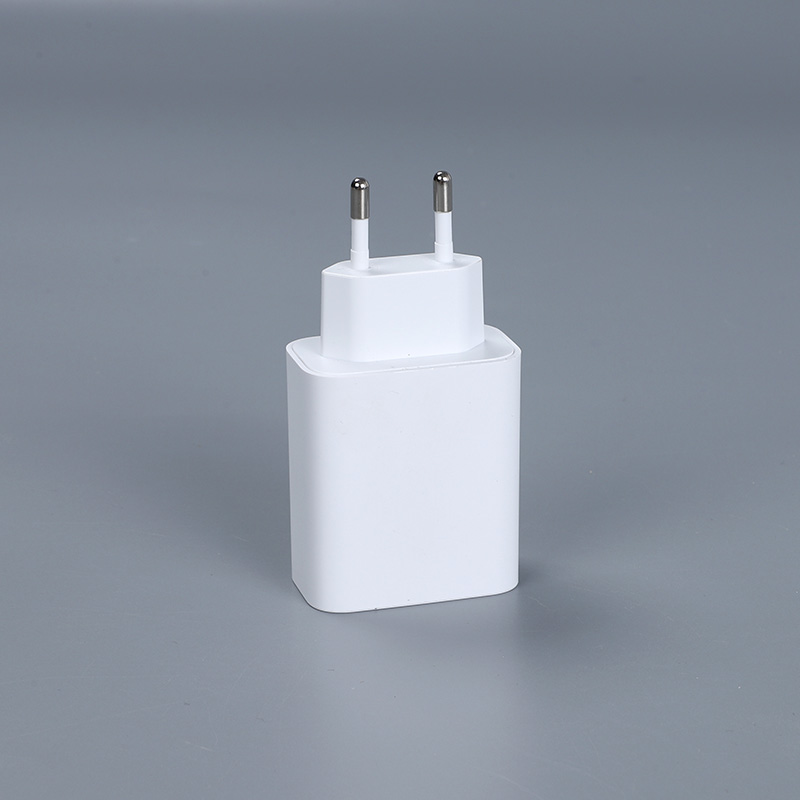
The Housing Is a Specification Item, Not a Colour
Product specifications routinely describe the housing as "white, PC + ABS" and treat the material decision as finished. It is not. Flame rating, glow-wire resistance, impact strength and dimensional stability under heat are independent properties, and a polymer blend chosen for one can fail another.
Dongguan Yisheng Electronic Technology Co., Ltd. manufactures household electrical products including USB power supplies, USB chargers, car chargers and USB power strips in Dongguan, Guangdong, exporting to more than 40 countries. Because those products operate permanently connected to mains voltage, the housing requirements are set by safety standards rather than by appearance.
UL 94 V0: What the Flame Rating Measures
UL 94 is a materials test, not a product test. A specimen of the material is held vertically and ignited; the classification records how long it continues to burn and whether it drips.
| Rating | Behaviour after ignition | Dripping |
|---|---|---|
| V0 | Self-extinguishes within 10 s per specimen; total after-flame ≤ 50 s for five specimens | No flaming drips that ignite cotton |
| V1 | Self-extinguishes within 30 s per specimen | No flaming drips that ignite cotton |
| V2 | Self-extinguishes within 30 s per specimen | Flaming drips permitted, cotton may ignite |
| V0 is the usual requirement for household electrical housings | — | |
The distinction between V0 and V1 is time; the distinction between V1 and V2 is whether burning material falls away from the part. For a housing mounted on a wall or sitting on a desk, falling burning material is the more dangerous behaviour, which is why V2 is rarely acceptable even where its after-flame time would pass.
An important limitation: UL 94 is tested on a specimen, not on a finished part. A supplier can legitimately hold a V0 certificate for a material and still produce a housing whose wall thickness, ribs or inserts behave differently. This is why product-level testing exists alongside material certification.
Glow-Wire Testing: The Test That Catches V0 Materials
Glow-wire testing, described in IEC 60695-2-11 (glow-wire end-product test) and IEC 60695-2-13 (glow-wire ignitability test for materials), applies a heated element to the part and observes two things: whether the material ignites, and whether flame spreads beyond the contact area.
For household appliances, common test temperatures are 550 °C, 650 °C, 750 °C and 850 °C, selected by the standard according to the part's proximity to current-carrying components. A housing that surrounds a mains terminal is typically held to a higher temperature than an outer cover.
The practical point for a buyer: a V0 rating does not imply a glow-wire pass. The two tests measure different responses — one to an open flame, one to a hot surface — and a material can excel at one while failing the other. When a specification states "V0" and stops there, it describes only half of the fire behaviour that matters.
Material Selection: PC, ABS and the Blends Between
| Material | Strengths | Trade-offs |
|---|---|---|
| Polycarbonate (PC) | High impact strength, good dimensional stability, good electrical properties | Higher cost; more sensitive to some solvents and to stress cracking |
| ABS | Good surface finish, easy to mould, lower cost | Lower impact and heat resistance than PC |
| PC + ABS blend | Balanced impact, heat and cost; the common choice for socket housings | Properties depend heavily on the blend ratio, which a name alone does not state |
| Flame-retardant grades of each | Reach V0 and higher glow-wire ratings | Additives can reduce impact strength and change surface appearance; processing windows narrow |
Two specification consequences. "PC + ABS" is not a ratio — 70:30 and 50:50 blends with the same label perform differently, so a buyer who needs a specific impact performance should specify it as a measured value rather than as a material name. Flame retardants change mechanical behaviour; a V0 grade of a blend may have lower notched impact strength than the unfilled version, which matters for a housing that will be dropped or wall-mounted.
The Testing Sequence a Socket or Charger Actually Goes Through
Certification is not a single event. For a mains-connected household product, the file normally includes:
- Material certification. UL 94 classification of the housing polymer, and glow-wire data for the grades used.
- Component certification. Ratings for the socket contacts, the cord, the plug and any internal fuse or breaker, each evidenced separately.
- Product safety testing. Input/output ratings, dielectric strength, leakage current, temperature rise under load, mechanical strength and resistance to heat and fire at product level.
- Electromagnetic compatibility. Conducted and radiated emissions, and immunity where the standard requires it.
- Substance compliance. RoHS restricted substances; REACH where the destination market requires declaration.
- Factory and process controls. For several certification routes, the manufacturing site is audited and the product is subject to follow-up inspection.
Two practical notes. The component evidence is often the long-lead item — a certified plug or a certified cord assembly is procured, not manufactured, and its certificate has to be current at the time of submission. Marking is part of the file: rating label content, warning text and language requirements differ by market and are inspected alongside the product.
Certification by Destination Market
| Market | Safety | EMC | Substance |
|---|---|---|---|
| United States | UL or ETL to the applicable UL standard | FCC Part 15 | RoHS (state-level requirements; CPSC as applicable) |
| Canada | cUL / cETL | ICES | RoHS as applicable |
| European Union | CE under the Low Voltage Directive, tested to the applicable EN standard | CE under the EMC Directive | RoHS, REACH |
| United Kingdom | UKCA | UKCA EMC | UK RoHS |
| Australia / New Zealand | RCM (electrical safety scheme as applicable) | RCM EMC | RoHS as applicable |
The certification route also depends on who is placing the product on the market. A buyer importing under their own brand is normally the responsible economic operator and holds the declaration; the factory supplies the test evidence and the technical file. Agreeing this division before sampling prevents the common situation where a product is ready to ship and the paperwork is not.
Housing and Certification Checklist
- Flame rating stated as UL 94 V0, with the material grade identified rather than the blend name alone.
- Glow-wire temperature stated (e.g. 750 °C) and matched to the part's position relative to live parts.
- Impact and heat performance given as measured values, not inferred from the material family.
- Component certificates identified for the socket contacts, cord and plug, with validity dates.
- Certification set listed by destination market, covering safety, EMC and substances.
- Responsible operator agreed — who holds the declaration and the technical file.
- Marking requirements confirmed, including rating label content and required language.
- Follow-up inspection obligations understood where the certification route requires them.
Housings and Files That Pass First Time
Most certification delays trace back to a specification that named a material instead of a property, or to component evidence that was assumed rather than confirmed. Stating the flame rating, the glow-wire temperature and the component certificates at the sampling stage moves those questions to where they are cheap to answer.
Send us your destination market and the product's intended use, and we will return a housing specification with the material grade, flame and glow-wire ratings, and the certification route and evidence list stated for each item, together with samples for evaluation.