
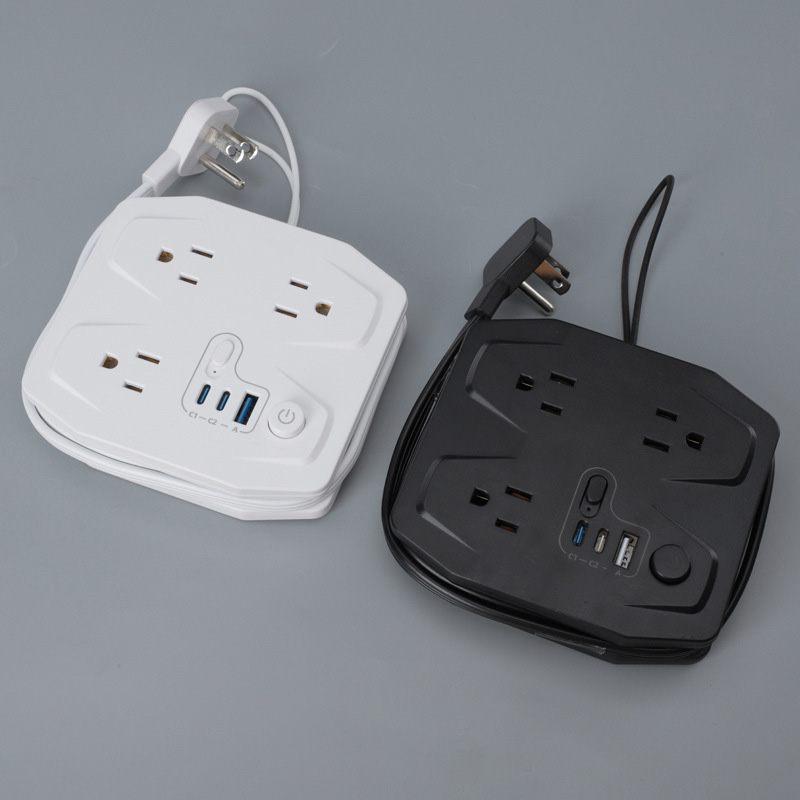
Why "Power Strip" Is Not a Specification
Two strips can both be described as a "4-outlet power strip" and be entirely different products. One carries 15 A through a 14 AWG cord and passes UL testing; the other carries the same four outlets through a 18 AWG cord rated for a fraction of the current. Both are sold as power strips. Only one is safe to load.
Dongguan Yisheng Electronic Technology Co., Ltd. has manufactured household electrical products in Dongguan, Guangdong since 2017, producing USB power supplies, USB chargers, car chargers, PCBAs and USB power strips for brands, importers and cross-border sellers in more than 40 countries. In that work, the specification lines that cause the most rework are the ones that name a product instead of defining one.
A complete power strip specification has five independent parts:
- Socket standard — the physical outlet geometry for the destination market.
- Current and voltage rating — the maximum the strip is certified to carry.
- Conductor size — the wire gauge inside the cord.
- Circuit protection — what happens when the load exceeds the rating.
- Housing and cord length — material, flame rating and physical reach.
1. Socket Standard: The Market Decision
The socket type is decided by the destination market, not by preference. The main standards a manufacturer will be asked for:
| Standard | Common designation | Voltage | Primary markets |
|---|---|---|---|
| US / North America | NEMA 5-15 | 120 V | United States, Canada, Mexico, Japan (with variations) |
| European | CEE 7/3 (Schuko), CEE 7/16 (Europlug) | 230 V | Germany, France, Netherlands, most of the EU |
| UK | BS 1363 | 230 V | United Kingdom, Ireland, Singapore, Hong Kong SAR, China, UAE |
| Australia | AS/NZS 3112 | 230 V | Australia, New Zealand, Argentina, China (GB 1002 is similar but not interchangeable) |
| Italy | CEI 23-16 | 230 V | Italy, and parts of North Africa |
Two details are routinely missed. First, "EU plug" is not one standard — Schuko (round recessed, with earth clips) and Europlug (flat two-pin, unearthed) are different products, and a buyer who needs Schuko will reject a Europlug sample even though both arrive from the same factory. Second, the socket and the plug are separate decisions: a strip for the European market may use a Schuko socket but be supplied with a Europlug lead, or the reverse, depending on the intended device set and local regulations.
For North American orders, NEMA 5-15 is the standard residential outlet: two flat blades plus a round earth pin, rated 15 A at 125 V. A strip built to NEMA 5-15 cannot be sold into a 230 V market, and a strip built to a 230 V standard cannot carry a NEMA 5-15 plug without an adapter that itself becomes a failure point.
2. Current and Voltage Rating: What the Strip Can Actually Carry
The rating on a power strip is a system rating, not a socket rating. The outlet, the internal busbar, the cord and the plug all have to be rated to the same value, and the assembly is only as strong as the weakest part.
| Rating | Voltage | Maximum power | Typical use |
|---|---|---|---|
| 10 A | 250 V | 2,500 W | European and UK domestic strips |
| 13 A | 250 V | 3,250 W | UK BS 1363 strips (fused plug) |
| 15 A | 125 V | 1,875 W | North American NEMA 5-15 strips |
| 16 A | 250 V | 4,000 W | Schuko strips, higher-draw appliances |
The figure that matters for the buyer is the derated continuous load. Standards such as UL 1363 in North America expect a power strip to carry only 80% of its rating continuously — meaning a 15 A strip is intended for 12 A of continuous load, or roughly 1,500 W. A buyer who plans to run a 1,800 W space heater from a 15 A strip is planning to operate at the full rating indefinitely, which is exactly the condition the derating rule exists to prevent.
Ask the factory for the rating of the assembly, not of the outlet component. A strip with four 15 A outlets is not a 60 A product; the entire strip is limited by the cord and the incoming plug.
3. Conductor Size: Wire Gauge and Why It Is the Safety Item
The cord is the part that fails silently. An undersized conductor heats under load, and heat inside a flexible cord is invisible until the insulation degrades.
| AWG | Approx. area | Typical usage in a strip |
|---|---|---|
| 18 AWG | 0.82 mm² | Short, low-current cords; not appropriate for a 15 A rated strip |
| 16 AWG | 1.31 mm² | Light-duty strips; acceptable only when the rating is reduced accordingly |
| 14 AWG | 2.08 mm² | Standard for 15 A North American strips |
| 12 AWG | 3.31 mm² | Heavy-duty strips and longer cords |
Two rules apply. Gauge and length interact: voltage drop rises with length, so a longer cord needs a heavier conductor to deliver the same performance at the far end. Gauge and rating must match: a 15 A strip supplied with an 18 AWG cord is either mislabelled or unsafe, and in either case unsuitable for the destination market.
When writing the specification, state the gauge explicitly — "14 AWG × 3 core, SJT jacket" — rather than relying on the amp rating to imply it. The amp rating states an intention; the gauge states a construction.
4. Circuit Protection: Overload, Surge and the Difference Between Them
These two protections are frequently sold as if they were the same feature, and they solve different problems.
Overload protection responds to too much current being drawn — a resettable circuit breaker or a fuse. It protects the strip and the building wiring from a load the strip was not designed to carry. On a UK strip this is often the fuse in the plug; on a North American strip it is normally a resettable breaker.
Surge protection responds to a brief voltage spike — a metal-oxide varistor (MOV) absorbing the excess energy. It protects the connected equipment from a transient, not from a sustained overload. Surge protection is rated in joules, and the joule rating degrades with each significant event; a surge-protected strip is a consumable, not a permanent fixture.
| Feature | Protects | Responds to | Rated in |
|---|---|---|---|
| Overload breaker / fuse | The strip and building wiring | Sustained excess current | Amps |
| Surge protection (MOV) | Connected equipment | Brief voltage transient | Joules |
| Overcurrent / overvoltage (on USB side) | Devices on USB ports | Fault on the charging circuit | Amps / volts |
A well-specified strip states which protections it has, not merely that it is "protected". The two are independently testable and independently priced.
5. Housing, Flame Rating and Cord Length
The housing material is a specification item with a measurable rating. V0 flame retardant is the UL 94 classification most buyers require for household electrical products: a vertical specimen self-extinguishes within ten seconds and does not drip flaming particles. A housing described only as "PC + ABS" states the polymer blend but not the flame behaviour, and two suppliers can both quote "PC + ABS" while supplying different flame ratings.
A related requirement is glow-wire resistance. IEC 60695-2-11/13 testing exposes the housing to a heated element — commonly at 750 °C for household appliances — and checks whether the material ignites and whether flame propagates. A housing that passes V0 at room temperature can still fail a glow-wire test, so the two should be specified together.
Cord length is a practical specification with a certification implication: the length affects voltage drop and, in some markets, the maximum permitted length for a given gauge. State it in metres or feet, and state whether it is measured as the total cord or as the usable length from the housing face.
Power Strip Specification Checklist
- Socket standard named by designation — NEMA 5-15, BS 1363, CEE 7/3 — not "US plug" or "EU plug".
- Plug standard stated separately from the socket standard, when they differ.
- Assembly amp rating stated, with the continuous derating requirement understood.
- Conductor gauge explicit — AWG or mm², with the number of cores and jacket type.
- Cord length stated with a definition of what is measured.
- Overload and surge protection listed separately, with the joule rating where surge protection is claimed.
- Flame rating (UL 94 V0) and glow-wire temperature (e.g. 750 °C) both stated.
- Destination market certifications listed by name — UL, ETL, CE, RoHS, FCC, UKCA as applicable.
Specifying a Strip That Clears Certification First Time
Certification failures are usually specification failures. A strip built to a correctly written specification — correct socket standard, matching gauge and rating, stated flame behaviour — presents far fewer surprises to a test laboratory, and the sample that passes is the sample that ships.
Send us your target market, outlet count and load requirement, and we will return a full specification with the socket standard, rating, conductor gauge, protection features and flame rating stated for each item, along with the samples to verify them.